First Impressions
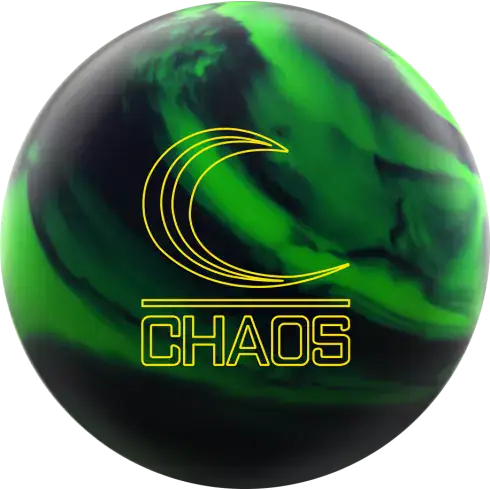
The Columbia 300 Chaos, released in January 2019, made waves when it hit the market because it brought high-end technical specs into the mid-price segment. Visually the ball is hard to miss: the "Green Envy" color scheme (a mix of bright lime green and black) stands out immediately on the lane. The surface comes out of the box with a coarse 500/2000 Abralon finish, which signals instant traction. Technically the ball is driven by the symmetrical Chaos Core. At 15 lbs, this core delivers a very low RG of 2.48 and a massive differential of 0.054. Those numbers are typically found in the highest price class and point to a ball that revs up extremely early and has enormous flare potential. This powerful engine is wrapped in the Exciter Solid Reactive shell. The combination of a matte solid cover with a low-RG, heavily flaring core is clearly aimed at maximum traction in oil and a heavy roll phase.
Comparison
Compared directly to the market standard for symmetrical solid balls, the Storm Phaze II, the Columbia 300 Chaos shows surprising parity in overall strength, but often comes across as a tick more aggressive in its change of direction. While the Phaze II is known for its extremely round and predictable motion, the Chaos uses its higher differential (0.054 vs. 0.051 on the Phaze II) to generate a bit more backend motion without sacrificing midlane stability. Set against the Ebonite Game Breaker 3, another classic in this segment, the Chaos is clearly stronger. It reads the oil earlier and covers more boards than the GB3. Against its in-house sibling, the Columbia 300 Savage (which is asymmetrical), the Chaos offers a smoother motion at the breakpoint. The Savage turns the corner more sharply and is more defined, while the Chaos describes a continuous arc that hides mistakes in release angle better.
On the Lanes
The Columbia 300 Chaos is made for medium to heavy oil patterns and works excellently as an aggressive benchmark ball. It's the first choice for reading the lane on a fresh house shot, since the 2000 surface keeps it from skidding over the oil and instead builds traction early. Its strength lies in the middle of the lane: it stabilizes the motion before it reaches the pocket, which makes it very controllable. It's especially suited if you need help getting the ball into a roll early (speed-dominant), or for situations where weaker balls skid too far. On dry lanes, or once the heads are burned up, it's less effective, since it would lose too much energy over the first few meters and arrive at the pins without power. It's a workhorse for volume that plows through the pins rather than snapping.