First Impressions
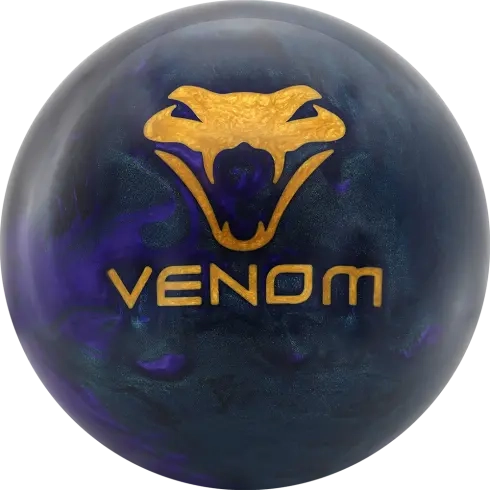
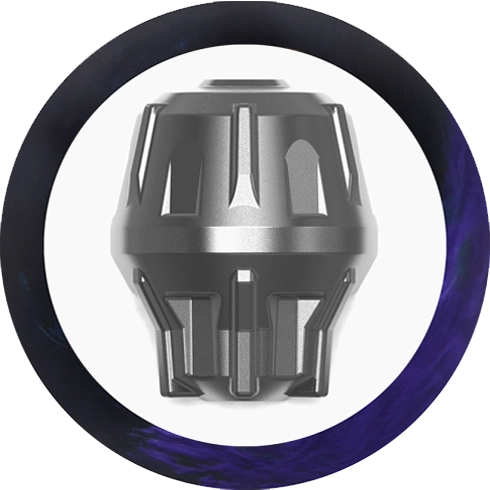
The Motiv Royal Venom is an international overseas release from November 2026, featuring a three-tone aesthetic of purple pearl, dark teal pearl, and black solid. Technically, the ball is built around the symmetrical Torx V3 weight block, an updated iteration of the Torx V2 core that produces a low RG of 2.48 and a high differential of 0.056 at 15 pounds. Surrounding this core is the Propulsion MXV Hybrid Reactive coverstock, finished out of the box at 3000 Grit LSS. By pairing a high-flare symmetrical core with a versatile hybrid shell, this release aims to blend the benchmark predictability of the Venom series with noticeably stronger mid-lane traction.
Comparative Analysis
Within the manufacturer's lineup, the Motiv Royal Venom offers substantially more overall hook and flare potential than the benchmark Motiv Venom Shock, which utilizes a lower 0.034 differential for tighter, smoother control. Compared to the Motiv Blue Coral Venom, the previous hybrid entry in the series, the Motiv Royal Venom relies on a symmetrical core rather than an asymmetrical design while increasing flare potential by ten percent over the earlier Torx V2 core. Its Propulsion MXV coverstock adapts the formulation originally introduced on the Motiv Evoke Hysteria into a hybrid blend. As a result, the Motiv Royal Venom clears the front part of the lane more effortlessly than heavier solid options like the Motiv Lethal Venom, yet creates earlier mid-lane friction and a more muscular overall shape than cleaner pearl offerings such as the Motiv Venom Hysteria.
Practical Application
In practical play, the Motiv Royal Venom is engineered primarily for medium oil conditions, serving as a stronger benchmark option when standard medium-oil balls lack sufficient downlane authority. The 3000 Grit LSS factory finish on the Propulsion MXV Hybrid cover is intended to provide easy length through the front before establishing a steady, reliable read in the mid-lane. Bowlers with balanced speed-to-rev ratios as well as speed-dominant players can rely on the 0.056 differential to generate a continuous, heavy-rolling path into the pocket without losing pin carry when moving further inside on the boards. Furthermore, because the symmetrical core moderates the response off the dry boards, the ball is designed to remain manageable during lane transition rather than overreacting sharply downlane.